


2021-07-28
1. The crane is equipped with a wireless remote control system. The remote control commands must be consistent with the original cab operation commands, and the system can switch between the two operation modes, matching the corresponding bell, lighting and other functions.
2. The crane is a four-mechanism five-speed control (in line with Chinese crane operation habits): main trolley, auxiliary trolley, main hook, and auxiliary hook.
View Details
Crane remote control wiring diagram
2021-07-27
The No. 2 line connects to the power supply, which are the black and brown wires. For example, if the remote control is 380V, connect it to 380V; if it is 36V, connect it to 36V. Never connect them incorrectly, as doing so will burn out the transformer inside the remote control. The operating voltage of the remote control is indicated on the remote control housing.
The orange wire connects to the power supply, which is the same as the operating voltage of the contactor on the crane. The red wire connects to the main contactor coil.
The yellow and green wires connect to the upper and lower contactors, the green and blue wires connect to the east-west direction contactors, and the gray and white wires connect to the north-south direction contactors. The pink wire is a spare wire and can be ignored.
View Details
2021-07-27
Overhead cranes bring great efficiency, convenience, and speed to production, but due to the inherent safety risks of machinery, the influence of the on-site usage environment and frequency, malfunctions frequently occur. This paper mainly analyzes the common mechanical failures of overhead cranes to reduce the number of repairs and achieve practical benefits. The following is an analysis of common mechanical failures and problems of overhead cranes.
I. Wire Rope
1. Failure Analysis
During operation, the stress on each wire rope is very complex, varying with the position of each wire in the rope. Even under the simplest tensile force, the stress distribution among each wire rope is different. The main reason for wire rope breakage is overload, which is also related to the number of times it is wound around the sheaves and drums. Each winding process involves a change from straight to curved and then back to straight, and the more windings, the easier it is to damage and break. Secondly, wire rope breakage is related to the diameter of the sheaves and drums it passes over, the working environment, the type of work, and maintenance conditions.
2. Preventive Measures
(1) During operation, the lifting weight of the crane should not exceed the rated lifting weight.
(2) The wire rope of the crane should be selected according to the type of work and environment. Applying lubricating oil to the rope core before rope making can reduce damage caused by friction between wires. Double-wrapped ropes have better flexibility, are easy to manufacture, and are the most widely used.
(3) Regularly lubricate the wire rope.
(4) Avoid sudden impact forces on the wire rope during crane operation.
II. Drum and Wire Rope Pressure Plate
The drum is an important load-bearing component of the crane. During use, it may experience thinning of the drum wall, holes, and fracture failures. These failures are caused by the mutual compression and friction between the drum and the wire rope. When the drum wall thins to a certain extent, it will fracture due to being unable to withstand the pressure exerted by the wire rope. To prevent such mechanical accidents, according to national standards, the drum should be replaced in time when the drum wall wear reaches 20% of the original thickness or cracks appear.
III. Gearbox Gears
1. Failure Analysis
The gearbox is an important transmission component of the overhead crane. It transmits torque through gear meshing, adjusting the high-speed operation of the motor to the required speed. During torque transmission, the gears may experience mechanical failures such as broken teeth, pitting, adhesive wear, and wear. The causes of gear failure are as follows:
(1) Fatigue fracture caused by short-term overload or impact load and repeated bending;
(2) Rough gear surface, stress concentration caused by protrusions, or unclean lubricant;
(3) Lubrication failure due to excessive temperature;
(4) Wear caused by hard particles entering the friction surface.
(5) Preventive Measures
(6) The crane should not be used under load. Starting and braking should be slow and smooth. Reversing should be prohibited except under specific circumstances.
(7) Lubricants should be replaced promptly, the housing should be cleaned, and the appropriate type of lubricant should be selected.
(8) Regularly check the cleanliness of the lubricating oil. Replace it promptly if it is found to be unclean.
View Details
Crane workshop emergency response plan for dangerous accidents
2021-07-22
I. Crane Distribution and Overview 1 1. Crane Distribution Diagram: 1 2. Basic Overview: 2 II. Purpose of Compilation 2 III. Basis of Compilation 2 IV. Scope of Application 2 V. Working Principles 3 VI. Emergency Rescue Organization and Responsibilities
View Details
2021-07-22
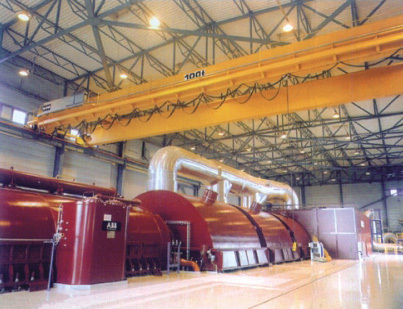
Ordinary bridge cranes generally consist of a crane trolley, a bridge traveling mechanism, and a bridge metal structure. The crane trolley is composed of three parts: a lifting mechanism, a trolley traveling mechanism, and a trolley frame.
The lifting mechanism includes a motor, a brake, a reducer, a drum, and a pulley block. The motor drives the drum to rotate through the reducer, causing the wire rope to wind onto or off the drum to lift or lower the load. The trolley frame is a frame that supports and mounts components such as the lifting mechanism and the trolley traveling mechanism, and is usually a welded structure.
The drive methods of the crane traveling mechanism can be divided into two categories: one is centralized drive, which uses a motor to drive the active wheels on both sides through a long transmission shaft; the other is separate drive, which uses a motor to drive each active wheel on both sides. Small and medium-sized bridge cranes mostly use a "three-in-one" drive method in which the brake, reducer, and motor are combined into one unit. For large-capacity ordinary bridge cranes, the drive device often uses a universal joint for easy installation and adjustment.
The crane traveling mechanism generally only uses four active and passive wheels. If the load is very large, the wheel pressure is usually reduced by increasing the number of wheels. When the number of wheels exceeds four, a hinged balanced frame device must be used to distribute the load of the crane evenly among the wheels.
The metal structure of the bridge frame consists of main beams and end beams, and is divided into two types: single main beam bridge frames and double beam bridge frames. A single main beam bridge frame consists of a single main beam and end beams located on both sides of the span, while a double beam bridge frame consists of two main beams and end beams.
The main beams and end beams are rigidly connected, and wheels are installed at both ends of the end beams to support the bridge frame running on the overhead track. Rails are welded onto the main beams for the crane trolley to run on. There are many types of bridge frame main beam structures, with typical ones including box structures, four-truss structures, and hollow truss structures.
Box structures can be further divided into several types, such as regular track box-shaped double beams, offset track box-shaped double beams, and offset track box-shaped single main beams. The regular track box-shaped double beam is a widely used basic form, consisting of upper and lower flange plates and vertical side plates. The crane rail is located on the center line of the upper flange plate. It has a simple structure, is easy to manufacture, and is suitable for mass production, but it is relatively heavy.
The cross-sections of offset track box-shaped double beams and offset track box-shaped single main beams are both composed of upper and lower flange plates and unequal thickness main and auxiliary webs. The crane rail is located above the main web, and the short stiffeners inside the box can be omitted. The offset track box-shaped single main beam replaces two main beams with one wide-flange box-shaped main beam, resulting in a lighter weight but more complex manufacturing process.
The four-truss structure is composed of four planar trusses to form a closed spatial structure. A walkway plate is generally laid on the surface of the upper horizontal truss. It is lightweight, has high rigidity, but compared to other structures, it has large external dimensions, complex manufacturing, and low fatigue strength, and is rarely produced.
The hollow truss structure is similar to the offset track box-shaped main beam, consisting of four steel plates to form a closed structure. Except for the main web being a solid web I-beam, the other three steel plates are cut into many windows according to design requirements, forming a hollow truss without diagonal braces. Walkway plates are laid on the upper and lower horizontal trusses, and the crane traveling mechanism and electrical equipment are installed inside the bridge frame. It is lightweight, has high overall rigidity, and is a widely used type in China.
Ordinary bridge cranes mainly use electric drive and are generally operated from a driver's cab, but remote control is also available. The lifting capacity can reach 500 tons, and the span can reach 60 meters.
Simple beam bridge cranes, also known as beam cranes, have a similar structure to ordinary bridge cranes, but with smaller lifting capacity, span, and operating speed. The bridge frame main beam is a simple section beam composed of I-beams or other steel sections and plate steel. A hand chain hoist or electric hoist is equipped with a simple trolley to serve as the crane trolley. The trolley generally runs on the lower flange of the I-beam. The bridge frame can run along the track on the overhead track or along the track suspended under the overhead track. This type of crane is called a suspended beam crane.
View Details
Contact Information
Mr. Tang +86-13168489951
No. 8, Fuguang Huanwei Street, Qingxi Town, Dongguan City, Guangdong Province

TDHAFU CRANES

Mobile Website