


What is an electric wire rope hoist? What are its characteristics?
Publication Time:
2022-11-15
Author:
Source:
Electric Wire Rope Hoist What is it? What are its characteristics?
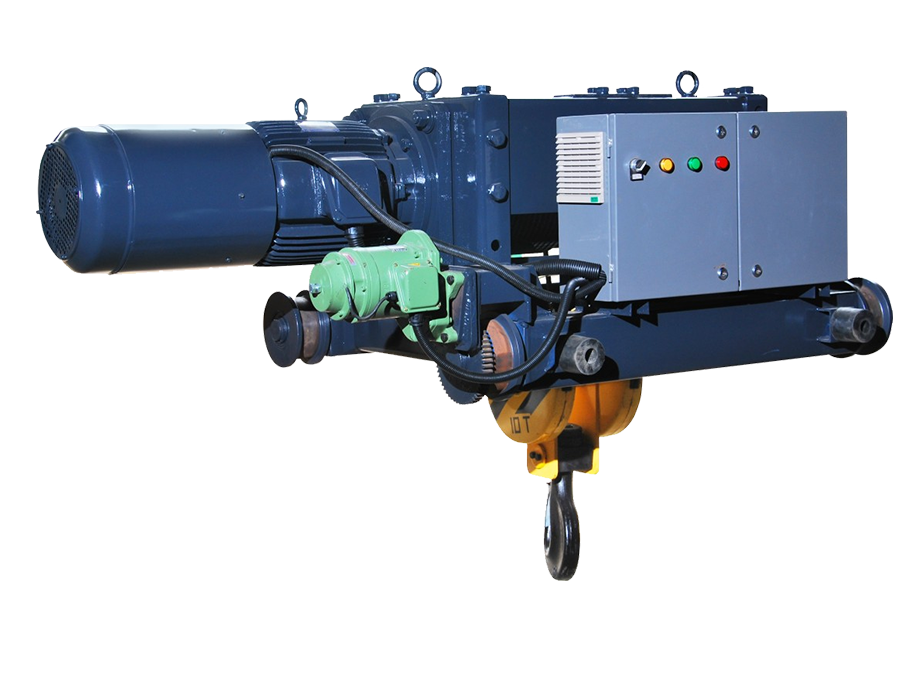
Electric Wire Rope Hoist It is a small lifting device with advantages such as compact structure, light weight, small size, strong parts versatility, and convenient operation. It is mainly used for lifting, hauling, loading and unloading, and inverted welding of various heavy objects, such as the installation and movement of various large and medium-sized concrete, steel structures, and mechanical equipment. It is suitable for construction installation companies, factories and mines, power, ships, automobile manufacturing, and civil engineering and bridge construction of construction machinery and equipment, such as highway, bridge, metallurgy, mining, slope tunnel, vertical shaft treatment and protection, and other infrastructure construction projects.
The wire rope electric hoist is also a special lifting device that can be installed on an I-beam alone or on electric or manual single-beam, double-beam, cantilever, gantry, and other cranes. The motor generally uses a conical motor, and the motor automatically locks the brake after stopping. The supporting wire ropes include phosphated coated wire ropes, galvanized wire ropes, and smooth wire ropes.
The components of a wire rope electric hoist include: motor, transmission mechanism, drum, and wire rope. According to the different positions of the motor and drum, it can be roughly divided into four types.
(1) Electric hoists with motor shafts perpendicular to the drum shafts use worm gear transmission devices, which have large width, heavy structure, low mechanical efficiency, and high processing difficulty. No manufacturer has ever produced such products.
(2) Electric hoists with motor shafts parallel to the drum shafts have the advantages of small height and length. Its disadvantages are large width, complex grouping, manufacturing, and assembly. The turning radius of the track is very large.
(3) Electric hoists with motors installed in the drum have the advantages of small length, small size, and compact structure. Its main disadvantages are poor motor heat dissipation conditions, poor grouping, inconvenient motor inspection, installation, and maintenance, and complex power supply devices.
(4) Electric hoists with motors installed outside the drum have the advantages of good grouping, high versatility, easy change of lifting height, and convenient installation and maintenance. Its disadvantage is: large length.
Electric Wire Rope Hoist The components can be roughly divided into:
1. Reducer 2. Drum device 3. Lifting motor 4. Electric trolley 5. Conical brake 6. Adjusting nut 7. Guide rope device 8. Coupling 9. Hook device 10. Control button 11. Hollow shaft 12. Housing 13. Seal ring 14. 09 gear 15. 06 gear shaft 16. 05 gear shaft 17. 04 gear shaft 18. Ball bearing 19. Roller bearing 20. Housing cover 21. Vent plug
The functions of each part are as follows:
Reducer: A fixed-axis helical gear transmission mechanism. Gears and gear shafts are made of heat-treated alloy steel. The box and cover are made of cast iron, assembled tightly, and well sealed.
Control box: A device that can cut off the main circuit in an emergency, and is equipped with a fire-proof limiter for up and down travel protection.
Wire rope: Heavy-duty wire rope is used to ensure durability. Conical motor: Asynchronous motor is braked by the high-power torque conical rotor of the lifting motor, without external braking.
Push-button switch: Manual operation, light and convenient, divided into rope operation and wireless remote control.
Recommended News
Analysis of various application scenarios and advantages of electric hoists
2025-01-13
2025-01-02
2024-12-23
Contact Information
Mr. Tang +86-13168489951
No. 8, Fuguang Huanwei Street, Qingxi Town, Dongguan City, Guangdong Province

TDHAFU CRANES

Mobile Website