


Some knowledge points about bridge cranes, told to you by the electric hoist bridge crane manufacturer
Publication Time:
2022-05-09
Author:
Source:
Electric Hoist Bridge Crane Manufacturers consider a crane a multi-motion lifting machine, also known as an overhead crane or hoist. It is a material handling machine. The characteristic of a bridge crane is its ability to vertically lift heavy objects suspended from a hook or other lifting device and move them horizontally in space. Bridge cranes include: lifting mechanisms and trolley running mechanisms. Through the cooperation of these mechanisms, lifting and handling heavy objects within a certain three-dimensional space becomes possible.
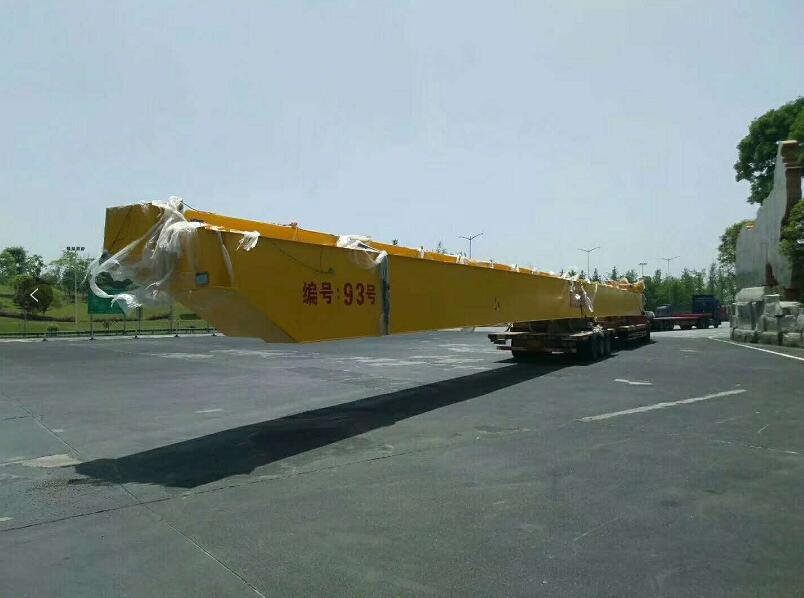
Electric Hoist Bridge Crane Bridge cranes are widely used in factories, warehouses, workshops, and yards for material lifting operations. Using this crane can greatly reduce labor intensity, improve work efficiency, and achieve mechanized and automated operations. Understanding the structure and working characteristics of gantry cranes can help us better operate and maintain them.
Electric Hoist Bridge Crane Bridge cranes and gantry cranes consist of trolley running mechanisms, lifting mechanisms, electrical systems, safety devices, and cabs. Gantry cranes are improvements on bridge cranes. There is one or two legs at both ends of the main beam, which can run along a dedicated track on the ground.
Electric Hoist Bridge Crane The main components of a bridge crane are the main beam, end beams, lower beam, and legs (gantry crane). Common main beams include box beams and truss beams. Truss beams are welded from steel pipes, and box beams are welded from steel plates. The cross beams are installed at both ends of the main beam and consist of plate beams, trusses, and wheels. Used to support the main beam. Gantry cranes (semi-gantry cranes) are equipped with rigid legs and flexible legs at both ends or one end, where the rigid legs are fixed to the bridge frame, and the flexible legs are connected to the gantry via a hinge axis.
The main working characteristics of bridge cranes are intermittent and cyclical. The crane lifts the material into place, loads it, transports it to the designated location, unloads it, and then returns to its original position to prepare for the next lift. This is one work cycle. The operation of the crane consists of multiple work cycles.
Electric Hoist Bridge Crane The trolleys of bridge cranes generally use self-propelled systems, while the trolleys of gantry cranes generally use traction systems. Self-propelled systems can be divided into centralized driving and separate driving. Centralized driving uses a three-in-one reducer and drive shaft to drive the wheels on both sides, while separate driving installs reducers on both sides of the main beam to drive the wheels. The trolley of a traction gantry crane uses a traction winch to drive the steel wire rope to pull the trolley along the track.
Electric Hoist Bridge Crane Daily maintenance of bridge cranes is also the basis for ensuring their normal operation. If this work is done well, it will greatly contribute to extending the maintenance interval, reducing workload, and improving equipment productivity.
Recommended News
Analysis of various application scenarios and advantages of electric hoists
2025-01-13
2025-01-02
2024-12-23
Contact Information
Mr. Tang +86-13168489951
No. 8, Fuguang Huanwei Street, Qingxi Town, Dongguan City, Guangdong Province

TDHAFU CRANES

Mobile Website